
Germany’s EV Transition May Be More Rural Than You Think
Electric vehicles are often associated with cities. Shorter journeys and greater visibility of public charging infrastructure might make metropolitan areas seem like the natural environment for EV adoption. However, EDW loan-level data on newly registered cars financed by employed borrowers in Germany between 2022 and 2025 tell a different story.
To explore the geographical dimension of EV adoption, we used the NUTS regional codes reported in the loan-level data and mapped borrowers’ locations to metropolitan, urban and rural areas using Eurostat’s regional classifications.
Eurostat uses NUTS regions as the basis for its territorial typologies, including classifications based on the degree of urbanisation and the proportion of the population living in rural areas.
Across the dataset, electric vehicles account for:
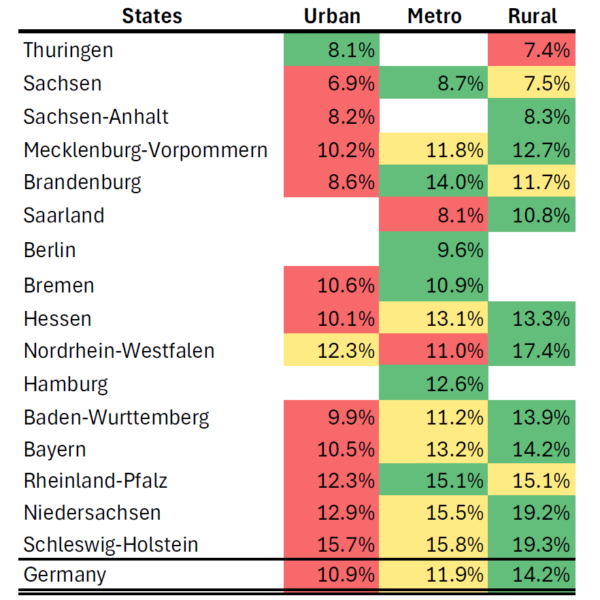
- 14.2% of financed cars among borrowers in rural areas
- 11.9% in metropolitan areas
- 10.9% in urban areas
This means that the share of EVs among rural employed borrowers is around 30% higher than among urban borrowers.
The pattern is particularly pronounced in several federal states. In Niedersachsen, EVs represent 19.2% of financed cars among rural borrowers, compared with 15.5% in metropolitan and 12.9% in urban areas. In Nordrhein-Westfalen, the rural share reaches 17.4%, compared with 11.0% in metropolitan and 12.3% in urban areas. And in Schleswig-Holstein, EVs account for 19.3% of financed cars among rural borrowers.
Why Might an EV Work Particularly Well in Rural Areas?
Table 1- Percentage of financed new cars registered between 2022 and 2025 that are electric, based on the total number of financed new cars; employed borrowers only.
Source: EDW All-in-One Database
At first sight, this may seem counterintuitive. Rural drivers may travel longer distances and have less access to public charging infrastructure. But for an employed borrower, much of the regular use of a car may consist of a relatively predictable daily commute. If this can comfortably be covered within an EV’s range, the driver does not necessarily need to rely on public charging during everyday journeys.
Housing may also play an important role. In rural areas, access to private parking and the possibility of installing a wallbox can make home charging much more practical. If a car can be charged at home every night, the home effectively becomes the filling station.
EDW data establishes that rural employed borrowers have the highest EV share. It is not clear whether commuting patterns or home charging cause this difference, but these are plausible factors when considering why an EV might fit particularly well with rural mobility.
But There is Another Important Factor: Income
Geography is only part of the picture. Across our German loan-level data, we also see a clear income difference between employed borrowers choosing electric and conventional vehicles.
For newly registered cars financed between 2022 and 2025, the average annual net income of an employed borrower choosing an Internal Combustion Engine vehicle is €35,061, compared with €45,974 for an employed borrower choosing an EV.
That is an income difference of €11,000, or approximately 31%. This is important for understanding the transition.
A rural household may have many of the practical conditions that make an EV attractive: regular car usage, a predictable commute, private parking, and potentially the ability to charge overnight. But the consumer still needs to be able to afford the vehicle and its financing.
Our data therefore point towards two important dimensions of EV adoption: practicality and affordability.
For many rural households, the practical conditions may already be favourable. The bigger challenge may be making the economics of going electric work for a much broader range of consumers. And this has implications beyond the automotive market. Securitisation can provide lenders with additional funding capacity to finance the transition, and an increasing share of EVs can consequently flow into Auto ABS portfolios. But capital-market funding alone cannot determine what consumers choose to buy.
For the EV transition to become truly mainstream, going electric needs to not only be a practical choice, but an affordable one for the average household.