

IS THE GERMAN AUTOMOTIVE DOWNTURN AFFECTING CAR LOAN DELINQUENCIES?
The German automotive industry is a cornerstone of the German economy. Recently, however, German manufacturers have faced growing pressure from Chinese competitors and from the transition from internal-combustion engines (ICE) to electric vehicles.
This shift is especially disruptive for the many ‘Mittelstand’ parts manufacturers that must reinvent themselves or scale back production. Parts shortages after the COVID-19 crisis have added to the pressure, leading to production cuts, restructurings, job reductions, cost-cutting programmes and capacity adjustments.
European DataWarehouse’s latest blog explores whether German regions with strong exposure to auto manufacturers have recently seen a rise in delinquency rates.
Tracking Delinquencies in Automotive Regions
The analysis draws on EDW’s German auto ABS dataset on second-hand car loans, which EDW has collected in its role as a securitisation repository since 2013, providing a consistent long-term time series. Regions are identified at NUTS 3 level, which is sufficiently granular in some cases to isolate areas with strong exposure to the German auto industry.
For instance:
- In Wolfsburg (Volkswagen), Ingolstadt (Audi), Dingolfing-Landau (BMW), a very high share of employment is linked to the auto industry.
- Some regions are exposed to automotive suppliers that must cope with the shrinking market for ICE components, such as Bamberg (Brose), Kassel (VW Components), Saarpfalz-Kreis (Schaeffler) and Saarland regions linked to ZF Friedrichshafen.
- Mercedes and Porsche are also associated with Stuttgart, and BMW with Munich. However, both cities have much broader economies than these carmakers alone. For that reason, we keep Munich and Stuttgart in the “Germany Other” category.
Where Are Delinquencies Rising?
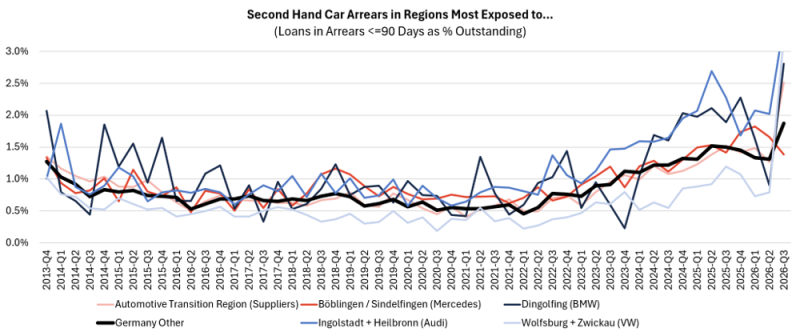
Exhibit 1 compares arrears levels in regions exposed to specific automotive manufacturers with an index covering all other German regions. Since 2013, arrears generally declined, stabilised, improved further until 2022 and then increased markedly. Automotive regions broadly follow this national pattern.
The main exception is the more pronounced deterioration observed in BMW- and Audi-exposed regions.
- Dingolfing-Landau (BMW) became a clear outlier from 2024 onwards. Delinquency levels started to diverge in late 2024 and remained elevated throughout 2025. The timing is broadly consistent with BMW’s production disruptions at Dingolfing in September 2024, which occurred amid weaker demand from China and issues linked to a large braking-system recall.
- Audi-exposed regions, notably Ingolstadt and Heilbronn/Neckarsulm, also experienced a marked deterioration from 2023 onwards. In March 2025, Audi announced a restructuring programme involving up to 7,500 job reductions in Germany by 2029, with Ingolstadt and Neckarsulm at the centre of the programme.
- Volkswagen-exposed regions remain surprisingly resilient. Delinquency levels in Wolfsburg and Zwickau are consistently below the German average, despite the pressures facing the Volkswagen Group. This may partly reflect the gradual nature of workforce adjustments, which have relied heavily on voluntary departures, attrition and negotiated programmes rather than large-scale layoffs. Political influence, including the shareholding of the State of Lower Saxony in Volkswagen, may also have contributed to a strong focus on employment preservation.
- Regions exposed to automotive suppliers and powertrain activities broadly track the national average and do not display the pronounced deterioration one might have expected given the challenges associated with the transition away from internal-combustion-engine technologies.
Exhibit 1: Delinquency Levels < 90 days in German regions Exposed to Auto Manufacturing
Source: EDW All in One Database; 2026 Q3 data incomplete (some July 2026 data only)
Comparing Automotive Regions with the German Average
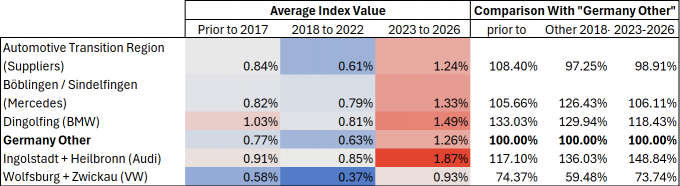
Exhibit 2 complements the time-series chart by comparing average arrears levels for each automotive-region category with the corresponding “Germany Other” benchmark over the same periods.
Exhibit 2: Average Arrears and Comparison with Germany Others
Source: EDW All in One Database; 2026 Q3 data incomplete (July 2026 only);
This comparison shows that several automotive regions already had above-average arrears before the recent downturn, while Volkswagen-exposed regions were the main exception.
EDW’s All-in-One Database provides the long-term perspective needed to identify these pre-existing performance differences, combining ECB and ESMA reporting to provide a consistent data history back to 2013.
A Broader Credit-Cycle Effect
The recent increase in arrears therefore appears to reflect, at least partially, a broad national credit-cycle effect. Regions most exposed to automotive suppliers and to the internal-combustion-engine transition thus performed broadly in line with the German average, while Volkswagen-dominated regions consistently outperformed it.
The persistence of the performance gap before the recent automotive downturn suggests that structural regional characteristics and borrower composition may be at least as important as recent labour-market developments.
Delinquencies in regions exposed to car manufacturing do not increase only when factories close. If the local automotive industry faces difficulties, first, production is reduced or shifts are cancelled. Factory workers, contractors and suppliers may work fewer hours and anticipate that they will earn less. In response, they may reduce discretionary spending, such as leisure activities and local retailers. Borrowers financing used cars, who are often more sensitive to income fluctuations than the average household, can therefore fall into arrears before broader signs of economic stress appear.
What Does the Data Reveal About the Automotive Downturn?
The EDW charts do not point to a simple nationwide automotive-credit shock. Automotive regions often exhibited higher delinquency rates even before the current downturn, while the recent increase in arrears broadly mirrors the wider deterioration observed across Germany.
The clearest additional deterioration is visible in BMW- and Audi-exposed regions, where the timing broadly coincides with production disruptions, weaker demand and restructuring announcements. By contrast, regions with high exposure to automotive suppliers and the transition away from internal-combustion-engine technology have generally performed in line with, or slightly better than, the German average.
This finding is noteworthy. Regions commonly viewed as most vulnerable to the automotive transition do not appear to be driving the recent increase in arrears. Instead, the data suggest that local labour-market conditions, borrower composition, securitisation selection effects and loan-management practices may be just as important as developments in the automotive industry itself.
The Value of a Longer Data History
The All-in-One database is particularly valuable for this type of analysis, because it combines the long ECB reporting history with ESMA data. This reduces the risk that the observed patterns are merely an artefact of the ESMA reporting period.
Auto ABS data was reported under the ECB framework from Q3 2013 and was gradually transitioned to the ESMA format from 2021. Relying solely on ESMA data therefore exclude several years of historical information and limit the ability to identify longer-term regional trends.
It is important to note nevertheless, that the database reflects only securitised assets. Eligibility criteria, originator mix, regional concentration, loan seasoning, transaction structure, and servicing practices can all influence measured arrears. In addition, loans exposed to severe local stress may be restructured, modified or repurchased from securitised pools, weakening the signal visible in the data.
The study used EUR 14 billion worth of loans as of Q2 2026, for which the “New or Used” field is explicitly mentioned as “USED” and the NUTS3 level could be identified. Out of this, an outstanding 55,000 loans accounting for 500 million was located in regions we identified as potentially impacted by the challenges of the auto sector.
The choice of index, up to 90 days in arrears including very short-term arrears, was meant to avoid making the sample of arrears too small, which would increase the volatility of the observations for the segments with the least data.
Conclusion
Overall, the data does not point to a uniform automotive-driven increase in car loan delinquencies across Germany.
BMW- and Audi-exposed regions show the clearest deterioration, while Volkswagen-exposed regions and areas with strong automotive supplier exposure have broadly followed the national trend.
The findings suggest that the recent rise in arrears reflects a combination of broader credit conditions and regional factors, rather than the impact of the automotive downturn alone.